1D motion
Distance (d, scalar) VS Displacement (Δd, vector)
Speed (d/t, scalar) VS Velocity (Δd/t, vector)
Acceleration (Δv/t, vector)
Position vs time graphs: graphs with constant slope would have constant velocity and zero acceleration.
Velocity vs time graphs: the area under any particular section of the graph between two times is equal to the displacement.
Acceleration vs time graphs: the change in velocity is represented by the area under this graph.
The kinematic formulas (if and only if the acceleration is constant)

Freely Falling/Flying Objects (FFO): only the force of gravity acts on an FFO.
2D motion and vectors
Vector components: horizontal component, vertical component
Component vector addition: adding up the individual components
2D kinematics and Projectiles: projectiles have vertical acceleration of a=-9.8m/s^2 and no horizontal acceleration a=0(Δx=vt). x and y components behave independently.
Forces and Newton’s Laws
Newton’s 1st Law: objects will maintain constant velocity(which could be 0), unless acted upon by an unbalanced force. If the forces are not balanced, the object accelerates.
Newton’s 1st Law does not apply to single objects. It applies to systems of objects as well.
Newton’s 2nd Law: ∑F=ma (this equation works for any single direction.)
Newton’s 3rd Law: If object A exerts a force on an object B, then object B must exert an equal and opposite force back on object A.
Force of gravity: downwards force on all objects exerted by the Earth, F=mg. (mass vs weight)
Normal Force: outward perpendicular force exerted by a surface, always pushes on an object.
Tension: force exerted by a string, rope, cable, cord, or any rope like object, always pulls on an object(cannot push on an object).
Kinetic Friction: force that tries to stop surfaces from sliding, does not depend on the velocity of the object, F=μFn.
Static Friction: force that tries to prevent surfaces from slipping in the first place
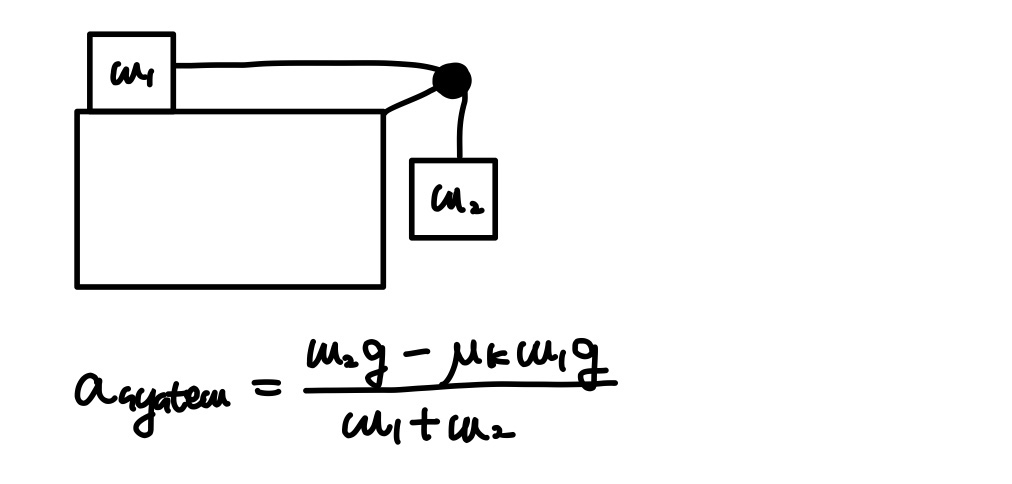
Treating systems as a single object: If 2 or more objects are required to move with the same speed/acceleration then we can treat them as a single object. This allows us to ignore internal forces and quickly find the acceleration.
Centripetal Forces
v=2πr/T
Centripetal Acceleration: causes a mass to travel in a circle, always points into the circle, only changes direction of velocity, a=v^2/r.
Centripetal forces are not a new type of force, it’s just a label for any of the regular forces we’ve already met that happen to be making something move in a circular path.
Energy and Work
Objects/systems can have energy and can transfer energy or transform it.
Energy can be transferred between objects/systems, which we call “doing work”. (W=ΔE)
Energy is conserved.
Types of Energy
K = kinetic energy = 1/2mv^2, due to motion
Ug = gravitiational potential energy = mgh, due to height
Us = spring potential energy = 1/2mkx^2, in a spring
ΔEth = thermal energy = Fkd, from friction/air resistance
E(mechanical energy) = K + Ug + Us
Work: the transfer of energy from one object or system to another, Fdcosθ.
Work Energy Principle: the total work done on an object is equal the change in kinetic energy of that object, Wnet=ΔK.
Power: the amount of work done per time(amount of energy transferred per time), W/t, ΔE/t.
 Possunt, quia posse videntur.